Our Approach: How Kincadence Builds a Formula
Most supplements start with a marketing angle. Kincadence starts with the biology of how you age, then builds one focused formula at a time around a clinically studied, named ingredient, dosed to match the research.
- Systems, not symptoms: we build for the everyday systems that decide how you age, starting with sleep and stress.
- A named, clinically studied active at the dose used in human studies, every other ingredient and dose on the label. No proprietary blends.
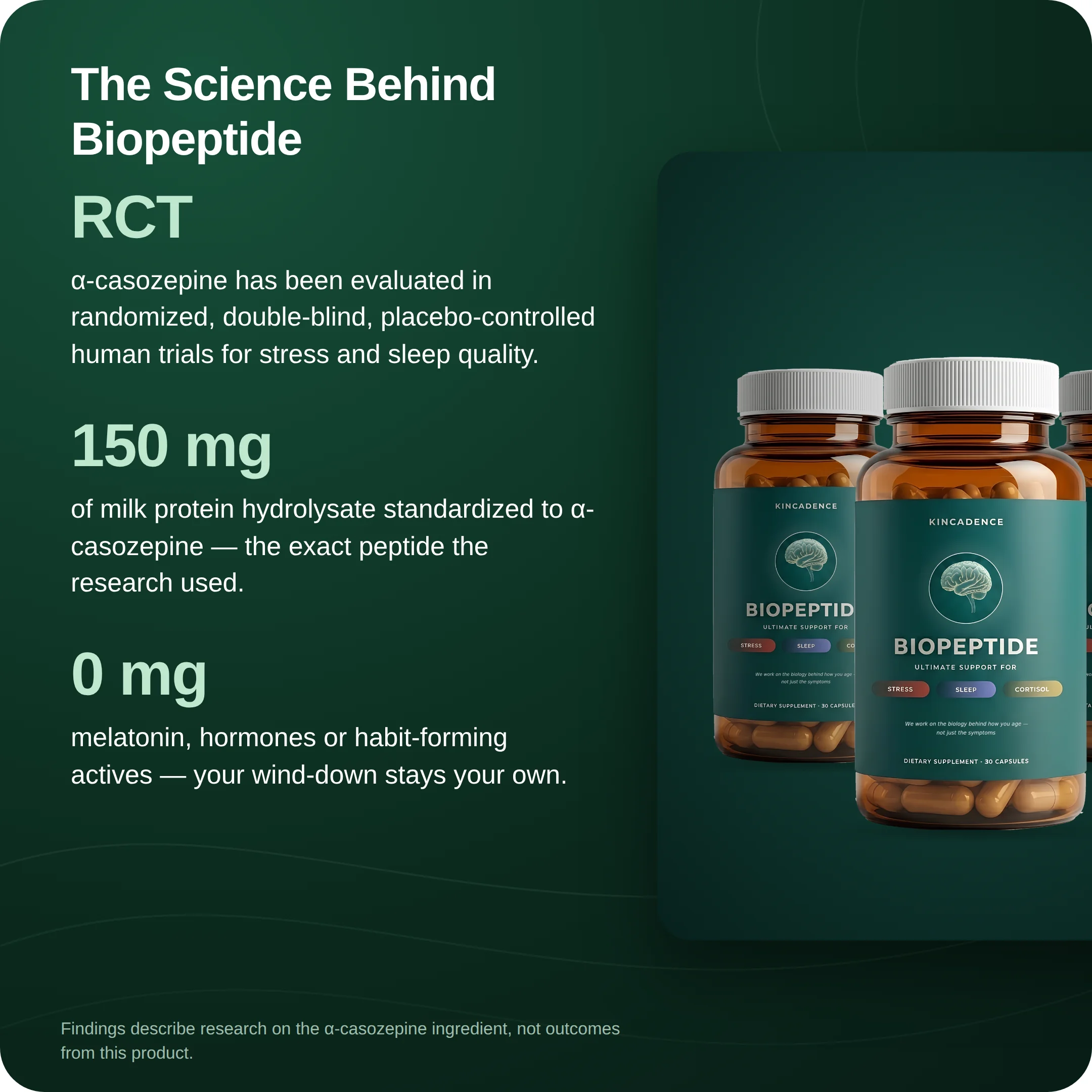
- No nightly hormones. Biopeptide is melatonin-free and works with your brain's own calming signal.
- Honest about limits: every claim is structure/function, every study is cited, every caveat is printed.
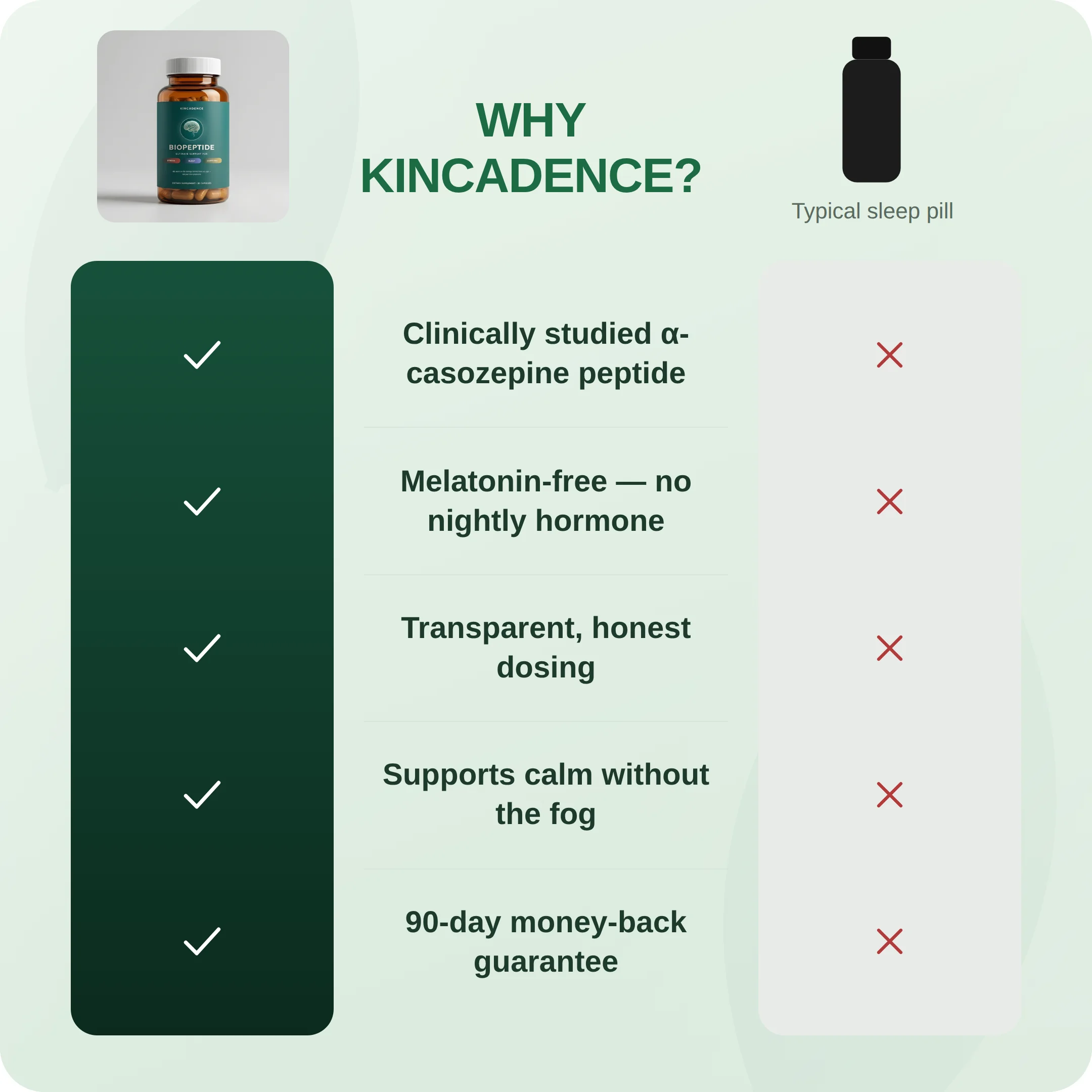
Six promises on every bottle
Five gates before anything goes in a capsule
Start from the system
We ask which everyday system is quietly shaping how you age, and which one people struggle with most. Sleep and stress came first.
Require human evidence
Mechanism is not enough. We look for randomized, placebo-controlled human trials before an ingredient is considered.
Name the exact form
The form studied is the form in the capsule, printed on the label with its dose. Nothing is hidden inside a blend.
Match the studied dose
Where a trial used a specific dose, we use it. If we cannot reach it, we do not pretend by listing a smaller amount.
Say what it does not do
We print each study's limits, keep claims to structure and function, and never put a disease name next to a product.
Six ideas behind every Kincadence decision
Systems, not symptoms.
Aging plays out in the body's everyday systems. We work on the system, so the benefit compounds instead of masking one symptom for one night.
Not a hormone. A signal.
Melatonin tells your body clock what time it is; it does not calm the reason you are wired. We chose a peptide that works with GABA, the brain's own calming signal.
Not less stress hormone. A better brake.
A stress response at the right size is healthy. GABA is the brake that sizes it. Supporting the brake beats trying to push a hormone down.
The studied dose of the active that matters.
A full studied dose of the key ingredient does more than a sprinkle of many. Supporting ingredients are listed with their exact doses, never hidden in a blend.
Quiet, not sedated.
The goal is a nervous system that stands down on its own, so you wake clear. If a product knocks you out, it is doing a different job.
Print the limits.
Early evidence is still early. We say so on the page, cite the papers, and refuse numbers that do not appear in one.
The systems that decide how you age
The leading causes of death in later life, among them heart disease, cancer, type 2 diabetes, Alzheimer's disease, chronic respiratory disease, kidney disease and liver disease, account for most of the global mortality burden. Cardiovascular disease alone is the single leading cause, at roughly 19.8 million deaths a year, about 32% of all deaths.1 A growing body of research suggests many of these conditions share common upstream drivers, among them how we sleep and how our cardiometabolic systems age.
We cannot change your genes. But the everyday systems that research links to long-term health, sleep among them, are exactly the ones clinically studied nutrition can support. That is where Kincadence focuses.
- In pooled cohort studies, consistently short sleep is associated with higher all-cause mortality. [2]
- Short sleep is associated with a higher risk of type 2 diabetes [3] and with obesity. [4]
- The WHO's IARC classifies night-shift work involving circadian disruption as probably carcinogenic to humans (Group 2A), a classification about shift work, not ordinary sleep. [5]
- Mechanistic studies link sleep to the brain's overnight clearance of metabolites including β-amyloid: early evidence from animal and small human studies, not proof of disease prevention. [6, 7]
- Under controlled viral exposure, shorter sleep has been associated with greater susceptibility to the common cold. [8]
- A stress response is healthy when it is the right size and switches off afterwards.
- Constant stress and stimulation keep overriding the brain's calming signal, so the off switch never fully flips, and the effect builds over time.
- Poor sleep and a wired stress response feed each other, which is why we treat sleep and everyday stress as one system.
- Associations reported in observational research do not establish cause and effect.
What Kincadence does, and does not, claim
Kincadence does not claim to prevent, treat, cure or mitigate heart disease, cancer, diabetes, Alzheimer's disease or any other disease. The research above describes the conditions and the body systems involved. It is general public-health education, not a claim about our products.
What we do: build clinically studied, structure/function nutrition that supports the everyday systems, calm and healthy sleep first, as part of a healthy lifestyle. Always talk to your doctor about your health, and never delay or replace medical care with a supplement.
The shortcuts we refuse
- No proprietary blends or hidden doses
- No disease claims, and no disease names next to a product
- No invented review counts, fake experts or borrowed authority
- No nightly hormones as a shortcut
- No under-dosing to hit a price
- No numbers we cannot trace to a peer-reviewed paper
Kincadence is a brand of Longevity Hub LLC
Based in Wilmington, Delaware. We ship to the United States, Canada and Australia, and every order carries a 90-day money-back guarantee. Customer care: care@kincadence.com.
See the science, then decide
The full ingredient page shows every study behind Biopeptide with its limits, and the FAQ answers the questions people ask before they try it.
- World Health Organization. Cardiovascular diseases fact sheet (2022 data; about 19.8 million deaths, about 32% of global deaths). Source
- Cappuccio FP, et al. Sleep duration and all-cause mortality: a systematic review and meta-analysis of prospective studies. Sleep. 2010;33(5):585–592. PMID 20469800. Source
- Shan Z, et al. Sleep duration and risk of type 2 diabetes: a meta-analysis of prospective studies. Diabetes Care. 2015;38(3):529–537. PMID 25715415. Source
- Cappuccio FP, et al. Meta-analysis of short sleep duration and obesity in children and adults. Sleep. 2008;31(5):619–626. Source
- IARC Monographs Vol. 124 (2019): night-shift work, Group 2A (first evaluated 2007). Source
- Xie L, et al. Sleep drives metabolite clearance from the adult brain. Science. 2013;342(6156):373–377 (animal study). Source
- Shokri-Kojori E, et al. β-Amyloid accumulation in the human brain after one night of sleep deprivation. PNAS. 2018;115(17):4483–4488 (small human study). Source
- Prather AA, et al. Behaviorally assessed sleep and susceptibility to the common cold. Sleep. 2015;38(9):1353–1359. PMID 26118561. Source
Associations reported in observational research do not establish cause and effect. These statements have not been evaluated by the Food and Drug Administration. This product is not intended to diagnose, treat, cure, or prevent any disease.