Why Do I Wake Up at 3 AM? The Science of Early-Morning Waking
- Waking briefly in the night is normal. The second half of the night is lighter sleep, so by 3 AM you are closer to the surface.
- Cortisol, your main stress hormone, is lowest around midnight and starts rising a few hours after you fall asleep. A stressed, switched-on nervous system can turn a normal brief waking into lying awake.
- Evening alcohol makes the first half of the night deeper and the second half more broken.
- Deep sleep decreases and night-time waking increases with age, so early waking gets more common in midlife.
1. The second half of the night is lighter sleep
Sleep runs in cycles, and the cycles change as the night goes on. In the first third of the night, light sleep alternates mostly with deep slow-wave sleep. In the last third, light sleep alternates almost only with REM (dream) sleep (Voss, 2004). By 3 or 4 AM the deepest sleep of the night is usually behind you.
Brief awakenings between cycles are normal, and most are forgotten by morning. The 3 AM problem is rarely the waking itself. It is not getting back to sleep.
2. Your stress hormone starts rising in the early hours
Cortisol follows a daily rhythm. It is at its lowest around midnight, starts to rise two to three hours after you fall asleep and keeps rising towards the morning (Hirotsu et al., 2015). That rise helps you wake up ready for the day, but it also means the body's alert system is gearing up just as your sleep gets lighter.
Stress feeds into this. Higher cortisol in the evening has been linked with more awakenings the following night (Hirotsu et al., 2015). When the day's stress has not settled, a normal brief waking can tip into a racing mind, and suddenly it is 4:30.
3. Alcohol moves the damage to the early hours
A drink in the evening can make it easier to fall asleep, which is why it feels like it helps. A review of all the studies on alcohol and sleep in healthy people found that, at every dose, alcohol shortened the time to fall asleep, consolidated the first half of the night and increased sleep disruption in the second half (Ebrahim et al., 2013).
4. It becomes more common with age
A meta-analysis of 65 studies found that in adults the share of deep slow-wave sleep falls with age, while time spent awake after first falling asleep rises (Ohayon et al., 2004). For many women, hot flashes and night sweats around the menopause add to this.
5. Everyday triggers
- Caffeine after mid-afternoon, which can still be active at bedtime.
- A warm bedroom, light from a street lamp or screen, and noise.
- Drinking a lot in the last two hours before bed.
- An irregular schedule, including very different weekend wake times.
- Pain or discomfort that is easy to ignore during the day.
What to do when you wake at 3 AM
- Do not check the time or your phone. Working out how many hours are left switches the brain on.
- Breathe slowly, with a longer out-breath than in-breath, and let your body go heavy.
- If you have been lying awake for what feels like 20 minutes or more, get up. Sit somewhere dim and do something quiet and dull until you feel sleepy, then go back to bed.
- Keep a notepad by the bed. Writing a worry down tells your brain it will not be forgotten.
What helps during the day and evening
- Get up at the same time every day, including weekends, and get daylight early.
- Set a caffeine cut-off in the early afternoon.
- If you drink, keep it early and light.
- Give yourself a wind-down hour: dim lights, no work email, something calm.
- Deal with the day's worries earlier in the evening, not at bedtime.
Where Biopeptide fits
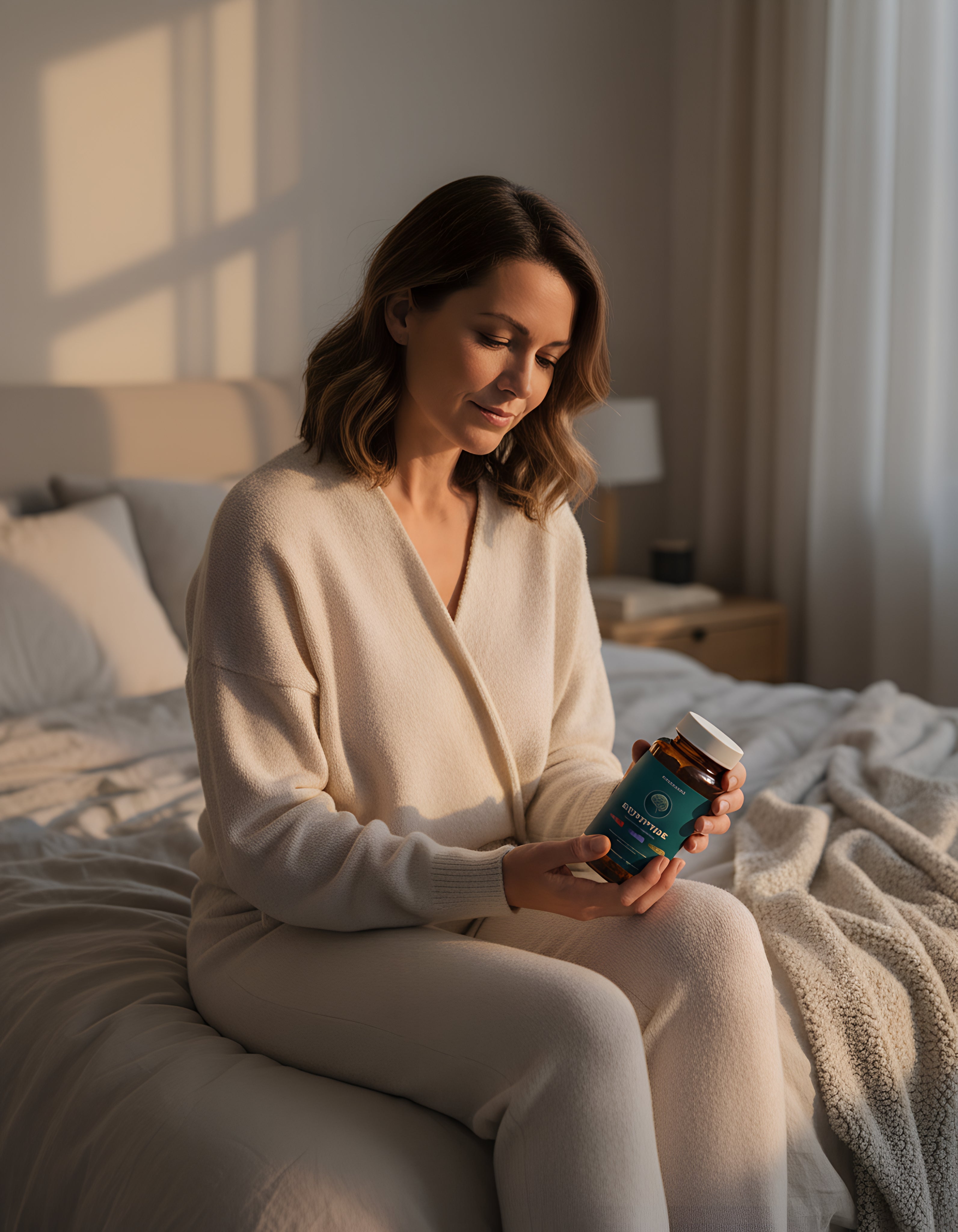
Biopeptide is built for the stress side of this pattern. Its active, α-casozepine, works with GABA, the brain's own calming signal, so a switched-on nervous system can stand down. It is not a hormone and not a sedative. Kincadence Biopeptide is one vegetable capsule a night with 150 mg of αS1-casein hydrolysate standardized to α-casozepine. It is melatonin-free and non-hormonal, and it contains milk. Take it 30 to 60 minutes before bed. Every order carries a 90-day money-back guarantee; the conditions are in our Refund Policy.
The human studies behind the ingredient, with their limits, are in What is α-casozepine?.
When to talk to a doctor
- You wake in the night most nights for a month or more and it affects your days.
- You or your partner notice loud snoring, gasping or pauses in your breathing.
- You often wake with a pounding heart or drenched in sweat.
- Low mood or constant worry has become part of the pattern.
- You take medicine that might affect sleep and want to check.
Early waking has many causes, and some need more than a routine change.
More from Kincadence Learn
What is α-casozepine?
Where the milk peptide comes from, how it works with GABA, and what five human trials found.
Read the article →Compareα-casozepine vs melatonin
A hormone that sets your body clock versus a peptide that works with your calming system.
Read the article →TimingHow long does it take to work?
What the studies measured at one day, two weeks and four weeks, and how to give it a fair trial.
Read the article →SafetyIs it safe every night?
What the trials report on tolerability, who should not take it, and what is still unknown.
Read the article →- Voss U. Reviews in the Neurosciences. 2004;15(1):33–46. Review of how sleep stages are arranged across the night. PMID 15046198. Source
- Hirotsu C, Tufik S, Andersen ML. Sleep Science. 2015;8(3):143–152. Review of how sleep, the cortisol rhythm and metabolism interact. PMID 26779321. Source
- Ebrahim IO, et al. Alcoholism: Clinical and Experimental Research. 2013;37(4):539–549. Alcohol and sleep I: effects on normal sleep. PMID 23347102. Source
- Ohayon MM, et al. Sleep. 2004;27(7):1255–1273. Meta-analysis of objectively measured sleep from childhood to old age in healthy people. PMID 15586779. Source
These statements have not been evaluated by the Food and Drug Administration. This product is not intended to diagnose, treat, cure, or prevent any disease. Statements about α-casozepine reflect published research on the ingredient, not on the finished product.