What Is α-Casozepine? The Calming Milk Peptide, Explained
- α-casozepine (alpha-casozepine) is a peptide of ten amino acids that comes from αS1-casein, the main protein in cow's milk.
- It is released when casein is broken down by enzymes. Supplements use a milk protein hydrolysate standardized to its α-casozepine content.
- It interacts with the GABA-A receptor, the brain's main calming system. It is not a hormone and it does not act on your body clock.
- Five published human trials, all of them small, point in an encouraging direction on everyday stress and sleep quality. The evidence is real but still early.
Where α-casozepine comes from
Most of the protein in milk is casein, and αS1-casein is one of its main forms. When casein is digested by the enzyme trypsin it breaks into short chains of amino acids called peptides. One of them, the ten amino acids at positions 91 to 100 of αS1-casein, is α-casozepine.
French researchers identified it in 2001 while looking for the part of a digested milk protein responsible for the calming effect it had shown in laboratory animals (Miclo et al., 2001). The name reflects that job: a peptide from casein that calms.
Supplements do not rely on a glass of milk. The enzyme digestion is done during manufacturing, which produces a milk protein hydrolysate with a measured amount of α-casozepine in every dose.
How it works
GABA is the brain's main calming messenger. It is the signal that tells your nervous system it is safe to stand down, and GABA-A receptors are where much of that signal lands. The 2001 study showed that α-casozepine binds to the GABA-A receptor, which explains the calming effect seen in animals.
That makes it a different kind of tool from melatonin. Melatonin is a hormone that tells your body clock what time it is. α-casozepine does not add a hormone and does not move your body clock; it works with the calming signal you already have. α-casozepine vs melatonin covers the difference in detail.
What the human studies show
These are the published human trials of αS1-casein hydrolysate standardized to α-casozepine. They tested the ingredient, not any finished product, and we list what each one does not show.
| Study | Who and how long | What was found | What it does not show |
|---|---|---|---|
| Kim et al., 2007 | 63 women with everyday stress symptoms; 150 mg a day for 30 days, compared with placebo in a crossover design | Fewer self-reported stress-related symptoms across several areas of daily life than on placebo | Symptoms were self-reported on a questionnaire, and no percentage improvement was published |
| Messaoudi et al., 2005 | Healthy volunteers; three doses over about a day, then a mental and a cold-water stress test | Smaller rises in blood pressure during the tests than with placebo; cortisol fell during the tests in the hydrolysate group but not the placebo group | A short laboratory test; it shows a physiological pattern, not a long-term outcome |
| Kim et al., 2019 | 48 adults (average age 49) with mild to moderate poor sleep; 300 mg a day for 4 weeks, crossover with placebo | During the hydrolysate phase, sleep diaries showed more total sleep, less time to fall asleep and less time awake at night; a wrist-worn sleep tracker showed better sleep efficiency after 4 weeks than after 2 | Questionnaire scales and the laboratory sleep test did not differ from placebo |
| Chang et al., 2024 | 36 adults with long-standing sleep difficulties; 600 mg a day for 2 weeks, then 300 mg for 2 weeks | Shorter time to fall asleep than placebo, measured in a sleep laboratory (polysomnography), plus better questionnaire scores | A small study at a higher dose than one Biopeptide capsule |
| Thiagarajah et al., 2022 | 39 working adults with poor sleep quality; 4 weeks | Better sleep-quality scores and longer sleep than placebo | The product combined the hydrolysate with L-theanine, so it cannot show what α-casozepine does on its own |
How strong is the evidence?
Honestly, early. There are five human trials, all small, several of them supplied or funded by ingredient manufacturers, and no meta-analysis yet. The direction is encouraging and the safety record in these trials is clean, but this is not the evidence base of a long-established nutrient. You will not see a "percent less stress" figure from us, because no peer-reviewed paper publishes one.
Common questions
Is α-casozepine the same as casein? No. Casein is the whole milk protein; α-casozepine is one small fragment released from it.
Can I get it from drinking milk? Milk contains the parent protein, but how much α-casozepine your own digestion releases from a glass of milk has not been established. A hydrolysate gives a measured amount.
Is it vegan? Is it safe with a milk allergy? No on both counts. It is made from milk protein, so it is not vegan and not suitable for anyone with a milk-protein allergy. More in Is α-casozepine safe to take every night?
α-casozepine in Biopeptide
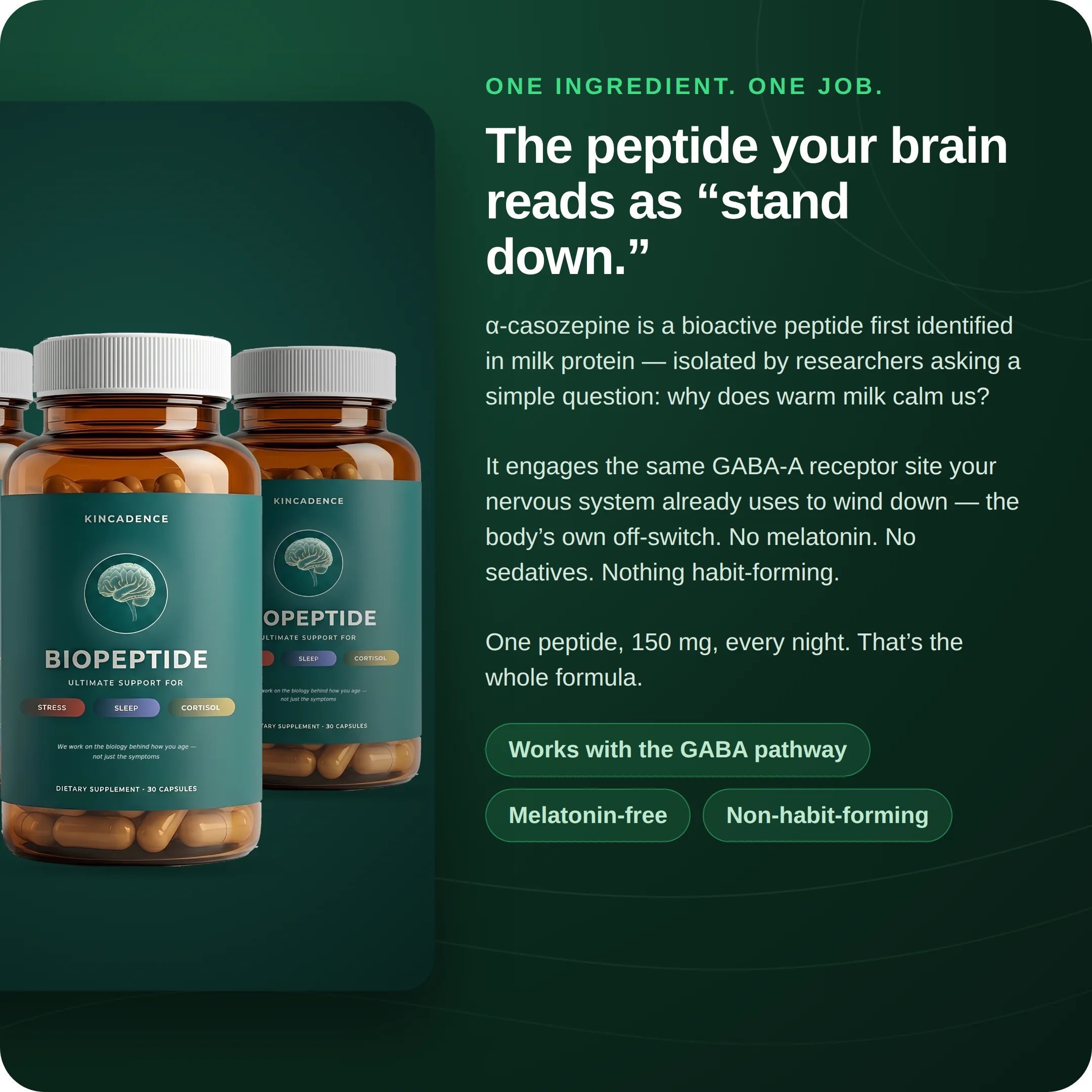
Kincadence Biopeptide is one vegetable capsule a night with 150 mg of αS1-casein hydrolysate standardized to α-casozepine. It is melatonin-free and non-hormonal, and it contains milk. Take it 30 to 60 minutes before bed. Every order carries a 90-day money-back guarantee; the conditions are in our Refund Policy. 150 mg a day is the amount used in the 30-day stress study; the sleep studies used 300 to 600 mg.
More from Kincadence Learn
α-casozepine vs melatonin
A hormone that sets your body clock versus a peptide that works with your calming system.
Read the article →TimingHow long does it take to work?
What the studies measured at one day, two weeks and four weeks, and how to give it a fair trial.
Read the article →SafetyIs it safe every night?
What the trials report on tolerability, who should not take it, and what is still unknown.
Read the article →SleepWhy do I wake up at 3 AM?
Lighter sleep late in the night, the early rise in cortisol, alcohol and age, plus what helps.
Read the article →- Miclo L, et al. The FASEB Journal. 2001;15(10):1780–1782. Identification of α-casozepine, a tryptic peptide of bovine αS1-casein, and its GABA-A receptor activity. PMID 11481228. Source
- Kim JH, et al. European Journal of Clinical Nutrition. 2007;61(4):536–541. Crossover, placebo-controlled trial of αS1-casein hydrolysate (150 mg/day, 30 days) on stress-related symptoms in 63 women. PMID 17136040. Source
- Messaoudi M, et al. European Journal of Nutrition. 2005;44(2):128–132. αS1-casein hydrolysate and blood pressure, heart rate and cortisol responses of healthy volunteers during laboratory stress tests. PMID 15517308. Source
- Kim HJ, et al. Nutrients. 2019;11(7):1466. Double-blind, randomized, placebo-controlled crossover trial of αS1-casein hydrolysate (300 mg/day, 4 weeks per phase) and sleep in 48 adults. PMID 31252661. Source
- Chang C-H, et al. Clinical Nutrition. 2024. Randomized, double-blind, placebo-controlled 4-week trial of αS1-casein hydrolysate and sleep measured by polysomnography in 36 adults. PMID 39541860. Source
- Thiagarajah K, et al. Nutrients. 2022;14(3). Randomized, placebo-controlled crossover trial of αS1-casein tryptic hydrolysate combined with L-theanine on sleep quality in 39 working adults. PMID 35277011. Source
These statements have not been evaluated by the Food and Drug Administration. This product is not intended to diagnose, treat, cure, or prevent any disease. Statements about α-casozepine reflect published research on the ingredient, not on the finished product.