α-Casozepine vs Melatonin: Two Different Ways to Approach Sleep
- Melatonin is a hormone your brain makes in response to darkness. It helps set the timing of your internal clock and your sleep.
- α-casozepine is a peptide from milk protein that works with GABA-A receptors, the brain's main calming system. It is not a hormone and does not act on your body clock.
- Melatonin's best-supported use is timing, such as jet lag. α-casozepine has been studied for everyday stress and sleep quality.
- If what keeps you up is a mind that will not switch off, a timing signal may not be the tool you need.
What melatonin does
Melatonin is a hormone your brain produces in response to darkness. It helps with the timing of your circadian rhythm, the roughly 24-hour internal clock, and with sleep (NIH NCCIH). A melatonin supplement is, in effect, an extra "it is night now" signal.
That is why the research on melatonin is strongest for timing problems. NIH's National Center for Complementary and Integrative Health says melatonin supplements may help with jet lag, and that there is not enough strong evidence to recommend them for long-term trouble sleeping.
In short-term studies the reported side effects were mild: headache, dizziness, nausea and sleepiness. NCCIH also notes that information on long-term safety is lacking, and that people taking medicine should talk to their health care provider before using it.
How much is really in a melatonin supplement?
In the US, melatonin is sold as a dietary supplement rather than a drug. A 2017 laboratory analysis of 31 melatonin supplements found actual melatonin ranging from 83% below to 478% above the amount on the label, and 8 of the 31 also contained serotonin (Erland and Saxena, 2017).
Label accuracy matters for every supplement, not only melatonin. It is the reason we print every dose on the label and have each batch tested by an independent laboratory.
What α-casozepine does
α-casozepine is a ten-amino-acid peptide from αS1-casein, the main protein in milk. It interacts with the GABA-A receptor, where the brain's main calming signal lands. Instead of telling your body what time it is, it supports the signal that tells your nervous system it is safe to stand down. Human trials have looked at everyday stress symptoms and sleep quality; What is α-casozepine? walks through each one and its limits.
Side by side
| Melatonin | α-casozepine | |
|---|---|---|
| What it is | A hormone made by the brain in darkness | A peptide from milk protein (αS1-casein) |
| How it works | Signals night to your body clock | Works with GABA-A receptors, the brain's main calming system |
| Is it a hormone? | Yes | No |
| Best-studied for | Jet lag and sleep timing | Everyday stress and sleep quality |
| Side effects in studies | Mild and short-term: headache, dizziness, nausea, sleepiness | No pattern of side effects in the published trials |
| Long-term data | Lacking, according to NIH | Trials lasted up to about 4 weeks per phase |
| Allergens | Depends on the product | Contains milk |
Which one fits your night?
- Crossing time zones or shifting your schedule: that is a timing problem, and timing is what melatonin is studied for.
- Lying awake with a racing mind, feeling tired but wired, or waking in the early hours and not settling: that pattern is about a nervous system that will not stand down, which is where α-casozepine has been studied. Why do I wake up at 3 AM? explains the biology.
- Not sure? Many people try a calming approach first because it does not involve a hormone.
Can you take them together? There is no known interaction between the two. If you take prescription medicine, ask your doctor before adding either.
Where Biopeptide fits
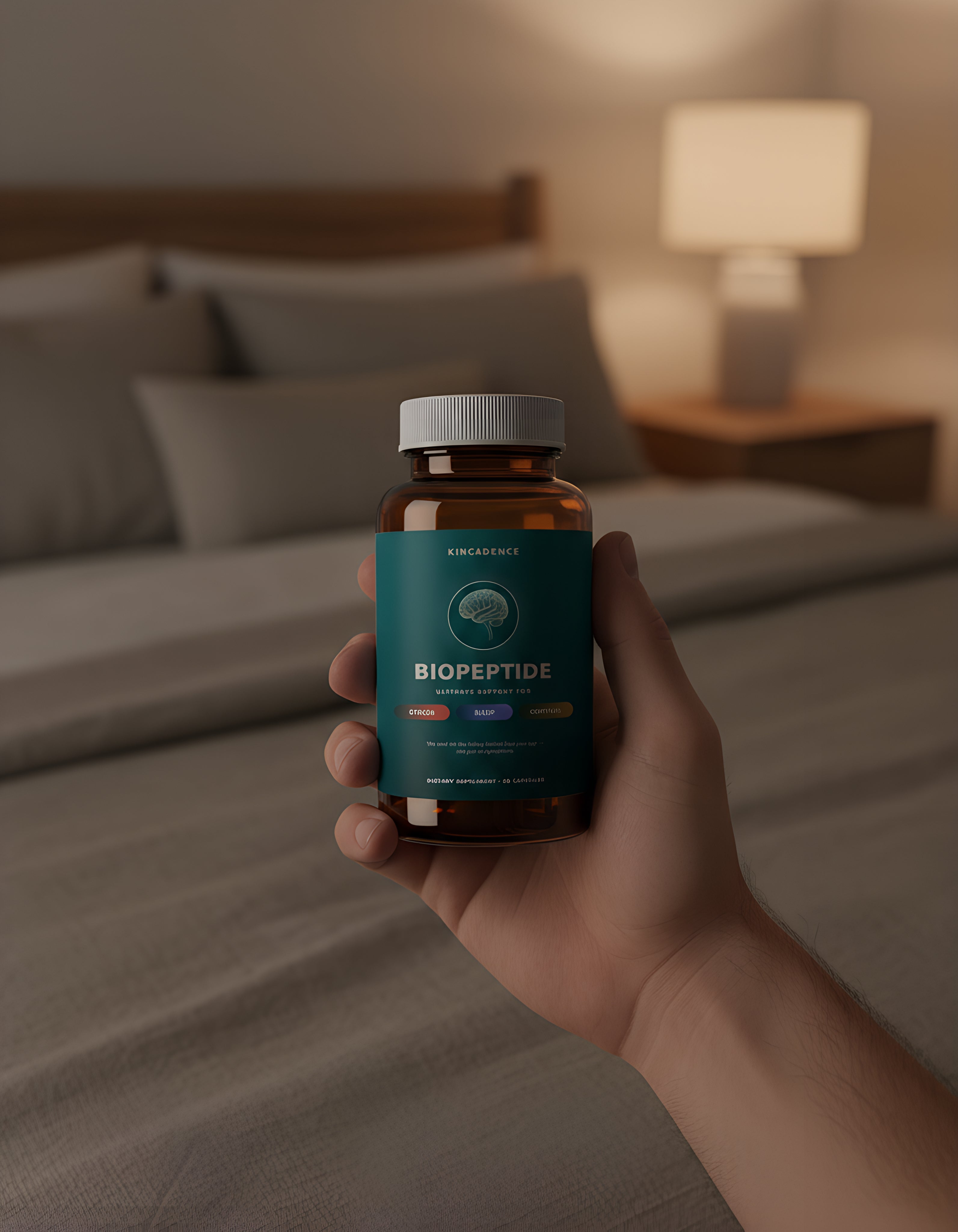
Kincadence Biopeptide is one vegetable capsule a night with 150 mg of αS1-casein hydrolysate standardized to α-casozepine. It is melatonin-free and non-hormonal, and it contains milk. Take it 30 to 60 minutes before bed. Every order carries a 90-day money-back guarantee; the conditions are in our Refund Policy. It contains no melatonin at all.
More from Kincadence Learn
What is α-casozepine?
Where the milk peptide comes from, how it works with GABA, and what five human trials found.
Read the article →TimingHow long does it take to work?
What the studies measured at one day, two weeks and four weeks, and how to give it a fair trial.
Read the article →SafetyIs it safe every night?
What the trials report on tolerability, who should not take it, and what is still unknown.
Read the article →SleepWhy do I wake up at 3 AM?
Lighter sleep late in the night, the early rise in cortisol, alcohol and age, plus what helps.
Read the article →- National Center for Complementary and Integrative Health (U.S. National Institutes of Health). Melatonin: What You Need To Know. Source
- Erland LA, Saxena PK. Journal of Clinical Sleep Medicine. 2017;13(2):275–281. Laboratory analysis of melatonin and serotonin content in 31 commercial melatonin supplements. PMID 27855744. Source
- Miclo L, et al. The FASEB Journal. 2001;15(10):1780–1782. Identification of α-casozepine, a tryptic peptide of bovine αS1-casein, and its GABA-A receptor activity. PMID 11481228. Source
- Kim JH, et al. European Journal of Clinical Nutrition. 2007;61(4):536–541. Crossover, placebo-controlled trial of αS1-casein hydrolysate (150 mg/day, 30 days) on stress-related symptoms in 63 women. PMID 17136040. Source
- Kim HJ, et al. Nutrients. 2019;11(7):1466. Double-blind, randomized, placebo-controlled crossover trial of αS1-casein hydrolysate (300 mg/day, 4 weeks per phase) and sleep in 48 adults. PMID 31252661. Source
These statements have not been evaluated by the Food and Drug Administration. This product is not intended to diagnose, treat, cure, or prevent any disease. Statements about α-casozepine reflect published research on the ingredient, not on the finished product.